
The AI Value Ladder: How to Move from AI Use to Organisational Value
Most organisations have now done the obvious things.
They have bought licences for AI tools. They have given people access. They have run training sessions. Employees have experimented with ChatGPT, Copilot, Claude or whatever sits inside the approved technology stack.
And then they wait.
They wait for adoption to increase. They wait for compelling use cases to emerge. They wait for productivity gains to show up. They wait for someone to demonstrate the ROI.
For many leadership teams, this is where the disappointment starts.
People use the tools, but not consistently. Some get excellent results; others complain that AI does not understand what they want. Promising experiments remain isolated. Productivity gains are difficult to see. The organisation is doing more with AI, but it is not obvious that the organisation itself has become more capable.
The problem is not that training failed.
It is that there is a much bigger distance between using AI and creating organisational value from AI than most organisations planned for.
The missing middle between AI adoption and AI value
We use a simple model to explain this: the AI Value Ladder.
There are five stages: Use → Skill → Workflow → Operating Model → Value
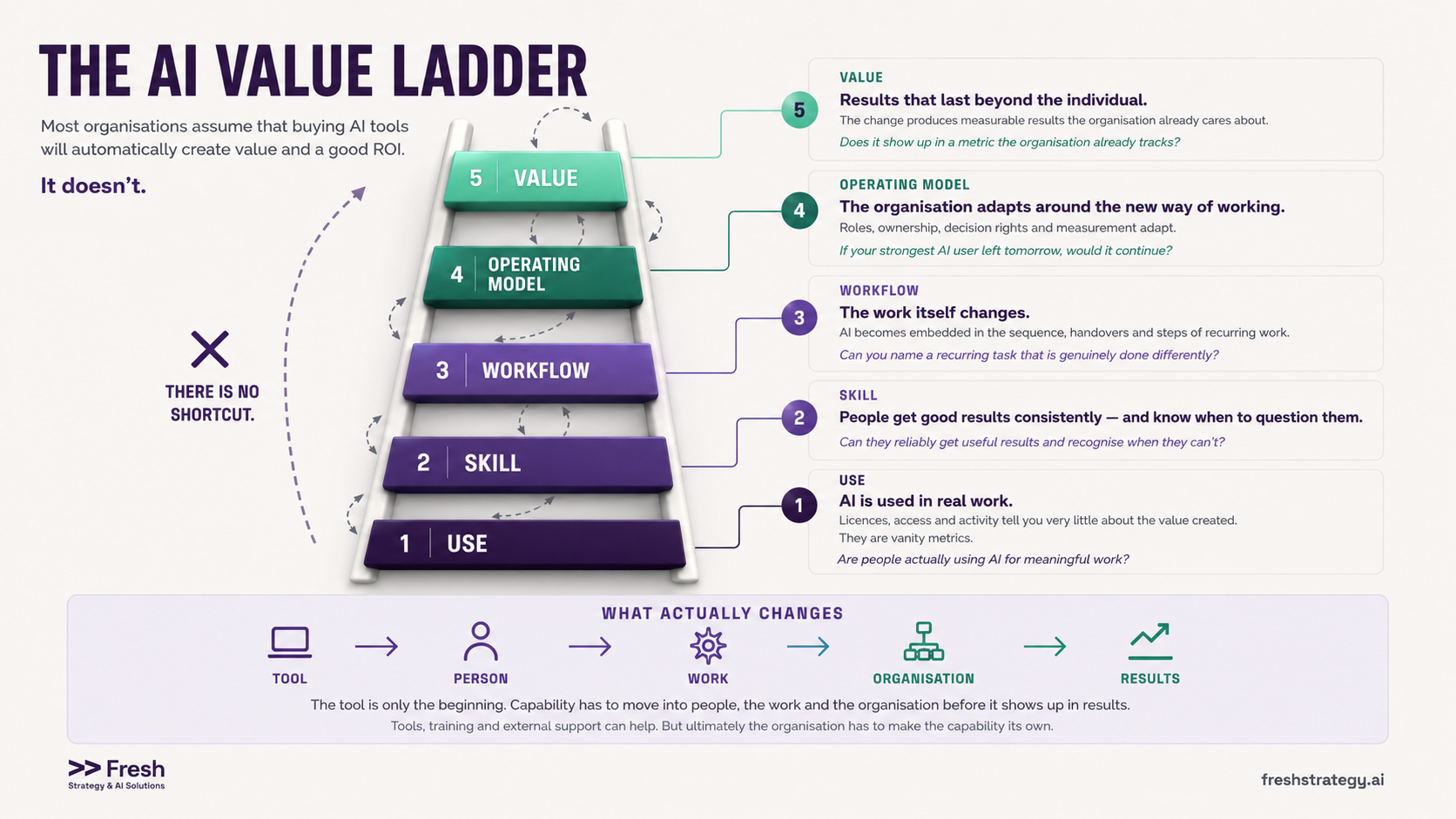
The first two are input territory - you can buy licences and run training. Stages 3-5 are where the work redesign happens. Most organisations confuse having completed stages 1–2 with having created value.
At the first stage, AI is being used in real work.
At the second, people become good enough at working with it to produce useful results consistently - and, just as importantly, to recognise when those results are not good enough.
Then something fundamentally different has to happen: AI becomes embedded in the sequence, handovers and recurring steps through which work gets done. Once that happens, the organisation around the workflow often has to change too: roles, ownership, decision rights, systems, governance and measurement.
Only then does the capability have a realistic chance of producing results at scale that persist beyond an individual user.
This is why licences, usage statistics and even training completion rates tell us relatively little about AI value. They measure activity near the bottom of the ladder.
The difficult work sits higher up.
Training still matters.
Good hands-on AI training is still important.
It gives people a safe starting point. It helps them understand what the technology can and cannot do. It develops judgement. It gives them techniques for producing better outputs. And increasingly in Europe, AI literacy is also part of responsible organisational governance.
But there is a substantial leap between somebody leaving a training session understanding how to work with AI and that person being able to get consistently strong results in their own job.
That capability develops through use.
They try something. It works. They try something else. It fails. They change the way they brief the AI. They discover that the problem is not the prompt but the information available to the model. They learn where human judgement matters. They develop better ways of checking the output.
This is why we see training as the beginning of a capability-building process rather than a stand-alone intervention.
Training creates the foundation.
Working on real work builds the capability.
Ongoing support helps people get through the frustrating period where they know AI could be useful but cannot yet make it useful reliably.
And that experience eventually reveals something much more interesting: where the work itself could change.
The biggest leap is from the person to the workflow
This is where many organisations get stuck.
An individual can change the way they perform a task relatively easily. A workflow is different.
Imagine a recurring newsletter or a member communication in a federation or association. One person may draft it. Another provides specialist input. Sales and Marketing edit it further. Someone approves it. Data comes from the CRM. Perhaps legal or policy colleagues need to review particular claims.
One person can use AI to improve their part of that process, which consists of drafting the newsletter. But they cannot redesign the whole process without involving their stakeholders.
The moment you ask what that workflow should look like if AI were deliberately built into it, you encounter questions about ownership, systems, handovers, quality standards, approvals and decision rights.
Different people control different pieces. They may have different incentives. They may not agree on what should change. Some changes require leadership decisions. Others require technology, governance or budget.
Suddenly a seemingly simple AI use case has become an organisational question.
That is precisely the point at which leaders can become overwhelmed.
The answer to AI overwhelm is not a bigger programme
Once leaders see the full scale of what AI may eventually change, the temptation is to create a transformation programme, build a roadmap and establish a steering committee. Then they catalogue hundreds of use cases and wait for leadership alignment.
Or do nothing until the technology becomes clearer.
Neither response is particularly helpful.
You do not need to redesign the organisation before you can start changing it. A useful starting point is to understand where your organisation is actually ready to move.
Generally speaking, you need to reduce the unit of change.
Take one recurring piece of work that matters. Give the people involved enough capability to experiment intelligently with AI. Help them test it against their actual work. Observe what starts to work consistently. Then bring together the people who control the relevant workflow and redesign only what needs to change.
Perhaps one approval disappears.
Perhaps information needs to enter the process earlier.
Perhaps a different tool is required.
Perhaps AI can prepare the first analysis but a human still makes the decision.
Perhaps responsibility shifts from producing something to reviewing and improving it.
Then measure something the organisation already cares about: turnaround time, quality, cost, capacity, member satisfaction, revenue or another meaningful result.
You do not need an abstract vision of the future operating model to begin. You need one piece of work that works better.
Then another.
Don't wait for the perfect use cases to appear
Most organisations cite lack of a clear use case as their top barrier to AI adoption - ahead of cost or skills. But waiting to identify perfect use cases reverses the learning sequence. Meaningful use cases rarely arrive fully formed.
People first need enough familiarity with AI to recognise what is possible. They need opportunities to experiment. They need permission to question how work is currently done. And they need access to people who can change the parts of the workflow they do not control.
In other words, use cases are often a result of capability building, not a prerequisite for it. Waiting until the organisation knows exactly where AI will create value reverses the sequence.
You learn where AI can create value by working with it.
Shadow AI is telling us something too
There is evidence that employees are already moving faster than many of the organisations around them.
Vanta reported in 2026 that 70% of companies in its data had AI tools accessing their environments that had not gone through the proper procurement process. That creates an obvious governance and security problem. But it is also an organisational signal.
People are making their own choices about the tools that help them do their work. That does not mean every unsanctioned tool is useful or should be allowed. Far from it. But simply treating shadow AI as undesirable behaviour misses an opportunity.
Leadership should also ask:
Why did somebody reach for that tool?
What were they trying to accomplish?
What could they do with it that they could not easily do inside the sanctioned environment?
Has a better way of working begun to emerge before the organisation has formally recognised it?
Shadow AI can therefore be both a risk to control and a source of information about unmet capability needs.
The more interesting question is not only “How do we stop people using unapproved AI?”
It is also “What is their behaviour telling us about how work is already trying to change?”
Build the capability to keep moving
The organisations that create value from AI will not necessarily be the ones that make the biggest initial investments.
They will be the ones that become good at moving capability through the organisation.
From a tool, to a person.
From a person, into the work.
From the work, into the structures that support it.
And eventually, into measurable results.
Research increasingly points in the same direction. McKinsey found workflow redesign to be the organisational practice most strongly associated with EBIT impact from generative AI. Yet only a minority of organisations have fundamentally redesigned workflows around it.
The opportunity is not simply to become better at deploying AI.
It is to become better at learning how the organisation should change around AI.
That requires training. It requires experimentation. It requires support. It requires leadership involvement. And eventually it requires changing workflows, roles and systems.
But it does not all have to happen at once.
Start with real work. Make the unit of change small enough to act on. Learn from what happens. Embed what works. Then move to the next piece.
You do not need to know today what your AI-enabled organisation will eventually look like.
You need a way of learning your way towards it.
